
The Voice in Your Head Matters: Teaching Girls Positive Self-Talk
Jan 09, 2026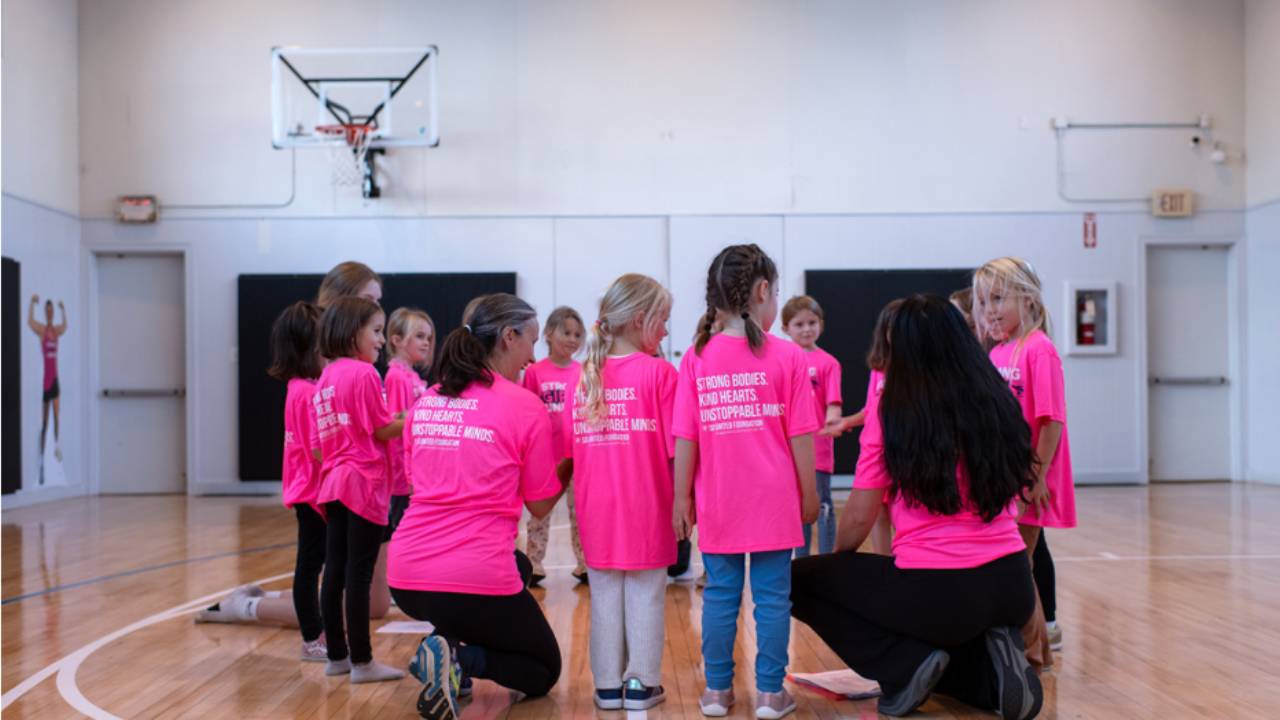
We all have a voice in our mind – whether it be when something feels challenging, uncertain, or even sure. When thinking of that voice that speaks to you, does it sound kind or unkind? Is that voice building your confidence or holding you back?
This week at Strong Girls United Hub, we began our first week back in the program, educating girls that self-talk isn’t something you’re born with – it’s a mental skill that can be learned, practiced, and aid in their ability to build strength over time.
When considering the research, there is abundant evidence in sport psychology, education, and youth development, showing that the way kids talk to themselves MATTERS. Studies have consistently shown that positive, instructional self-talk can enhance confidence and focus, reduce anxiety and stress, increase persistence following mistakes, and support emotional regulation during challenging situations. Ultimately, when girls learn how to speak to themselves with encouragement instead of criticism, their brain feels safer, more capable, and adaptable to their environment, and they are more willing to try new things.
Here at Strong Girls United, self-talk is integrated into various types of movement and physical activities, as well as exploration and reflection on self-talk, and education on skills that empower girls to feel more confident and competent. By practicing these skills during movement and challenge, girls learn how to use their voice when it matters most.
Positive self-talk doesn’t mean ignoring hard feelings or pretending things are easy.
It means learning how to support yourself through difficulty. Girls who build this skill carry it into school, sports, friendships, and everyday life — developing confidence that grows from the inside out.
Because confidence isn’t about never struggling.
It’s about knowing how to speak to yourself when you do.
Try This at Home:
This week, ask your child: “What did you say to yourself when something felt hard?”
Then help them choose one encouraging phrase to practice next time.
Small words. Big impact!
- Lilly!!
References:
Hatzigeorgiadis, A., Zourbanos, N., Galanis, E., & Theodorakis, Y. (2011). Self-talk and sports performance: A meta-analysis. Journal of Sport & Exercise Psychology, 33(3), 348–368. https://doi.org/10.1123/jsep.33.3.348
Hardy, J., Oliver, E., & Tod, D. (2009). A framework for the study and application of self-talk in sport. Journal of Applied Sport Psychology, 21(4), 432–449. https://doi.org/10.1080/10413200903026003
Zourbanos, N., Hatzigeorgiadis, A., Bardas, D., & Theodorakis, Y. (2013). The effects of a self-talk intervention on elementary students’ motor task performance. Psychology of Sport and Exercise, 14(1), 109–116. https://doi.org/10.1016/j.psychsport.2012.07.004
American Psychological Association. (n.d.). Cognitive restructuring and self-talk in children and adolescents. https://www.apa.org
National Association of School Psychologists. (n.d.). Building resilience and coping skills in children and youth. https://www.nasponline.org
Harvard Center on the Developing Child. (n.d.). Executive function & self-regulation. https://developingchild.harvard.edu
Mindset Works. (n.d.). Growth mindset research. https://www.mindsetworks.com
Stay connected with news and updates!
Join below to receive the latest news and updates from our team.
No spam, just the good stuff!

